What is the notion of time like for dogs?
Numerous studies confirm that dogs can perceive the passage of time through their senses.

CAN YOUR DOG MEASURE TIME?
Approximate reading time: 8 minutes
Humans process time very differently from animals. We have clocks and calendars, but for dogs, their instincts and senses take over. Over the years we have heard many stories about dogs waiting for children to come home from school for several minutes before they can smell or hear them. Who does not remember the touching true story of Hachiko and his owner? This Tokyo teacher came home from work every day by train and his pet sat waiting for him at the station every day, something he continued to do for years (even after his master's death). It seems clear that dogs can somehow measure time and anticipate certain events. Want to find out if your dog detects the time that has passed while you are away?

Table of contents
• Smell: your dog's most important sense
2. Does your dog suffer if you spend too much time outside?
How do dogs process time?
In recent years, a number of scientific studies have been carried out to investigate how dogs measure time. It seems that there are several processes that allow our pets to know what time of day it is and to distinguish short intervals of time from long intervals of time.
• The biological clock of dogs

Like all animals, dogs are governed by circadian rhythms, also known as the biological clock. Circadian rhythms are driven by changes in the amount of sunlight, determined by the earth's rotation and translation movements. Our furry friends are influenced by this, and depending on the amount of light, they exhibit changes in blood pressure, digestive processes, body temperature or sleep phases. These internal changes in the dog's body are very useful for them to discern what time of day it is.
• Daily routines
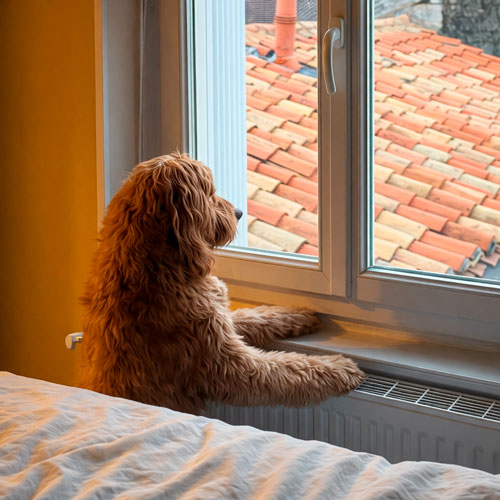
Dogs are highly intelligent and observant animals. As social beings intimately linked to the humans they live with, they learn to manage time through our cues, behaviours and routines. In this way, your dog can order times of the day and predict certain actions. For example, if you give your pet a cuddle and play session every time you come home from a walk, your pet will learn that this is the time of day and will demand it if you don't do it. This is why routines are so important for dogs. Living an orderly life will give them greater security as they can sense, through observation and learning, what is going to happen next.
• The senses of sight and hearing

In addition to circadian rhythms, dogs can determine the amount of light in the environment through their eyesight. Their eyes can also pick up all kinds of details that vary throughout the day and learn about them. The same goes for sounds: a jingle of the keys at the time you always go out can let your dog know it's time for a walk, whereas at other times of the day it might not be so effective. Dogs cross-reference all sorts of information that comes to them through their internal clock and senses to determine what time of day it is.
• Smell: your dog's most important sense

However, the most fascinating time-measuring mechanism in dogs is the one that measures the concentration of a scent in the environment. Smell is the most important sense of these animals, so much so that their ability to smell is estimated to be 10,000 to 100,000 times more powerful than that of people. In addition, they have a dual olfactory system: through the nose and the so-called Jacobson's organ, located near the roof of the mouth. This organ picks up volatile particles such as pheromones and other chemicals that are imperceptible to the human nose. The changes that occur in odours throughout the day can be detected by the dogs' privileged noses, which are thus able to locate themselves in time.
• The scent of your scent
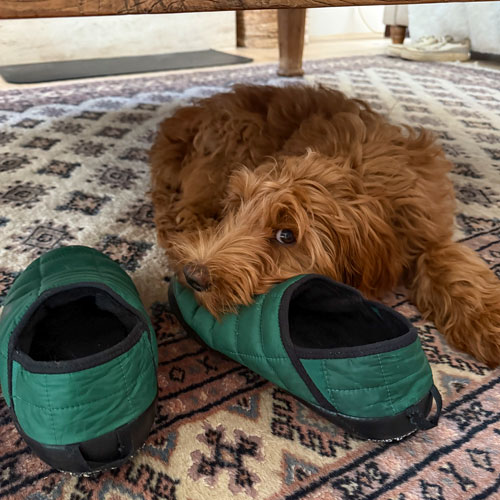
So fine and sophisticated is your dog's sense of smell that they can measure time through it. How? Through the intensity of a scent at a given moment. An interesting study by the Swedish University of Agriculture Sciences in Uppsala found that dogs became more nervous the longer it took for their owners to return home. After a few minutes, the dogs were calmer than when the absence lasted for hours. In addition, they became more restless a few minutes before their owners' arrival. This shows us that our pets do have a sense of time and that this works mainly through their sense of smell.
Dogs perceive that their owners' scent is strongest when they have just left and, as the hours pass, they notice how it dissipates. With this measurement of scent intensity, a dog can determine that when their nose detects that a scent has faded to a certain point, it is time for their owner to return. This is explained by researcher Alexandra Horowitz, who states that it is through present (stronger) and past (fainter) scent traces that dogs are able to develop a sense of time. In fact, the scientist herself tells in her study how, when she was a child, her dog would wait for her every day in the same place when she came home from school, guessing the exact time of her return.
Does your dog suffer if you spend a lot of time outside?
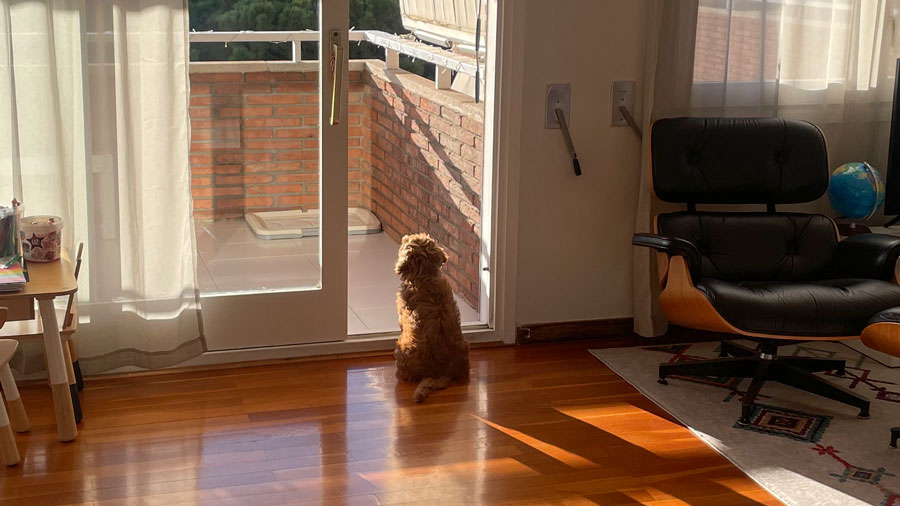
Now that you know that your pet can tell if you've been away for a short or long time, you're probably worried that they'll miss you. We're not going to kid you: you're very important to your dog. Your companionship and affection are vital to them so they miss you deeply when you're away. Some studies show that the more time passes since the owner's departure, the more signs of nervousness a dog shows, anticipating that the arrival is coming soon. In other words, your dog becomes happy just at the thought of you finally coming home to their side.
But don't worry, just because your beloved pet has a sense of time and misses you doesn't necessarily mean that they will suffer in your absence. Although some dogs are more independent than others, a healthy dog won't have a hard time when you're away. However, there is such a thing as separation stress, a canine behavioural disorder that can bring a lot of suffering to your dog if they suffer from it. If you notice that your pet cries, scratches at the door, destroys things, urinates, vomits or performs repetitive actions when left alone, it is very likely that they are suffering from separation stress. In this case, we advise you to consult a veterinarian or ethologist for help. Don't be alarmed: this behavioural disorder is solvable. With training, positive reinforcement and lots of affection, your dog is sure to improve.
In this sense, although the Australian Cobberdog enjoys the company of people and establishes strong bonds with them, they can also spend time alone and love to entertain themself playing, train them from puppyhood to spend small moments alone and progressively they will be able to stay for longer periods of time without stress.
The notion of time exists for your dog, so whenever you return home once they have calmed down remember to greet them lovingly and spend quality time with them every day so that they enjoy a healthy and happy life at your side.